The Impact of Statins and Anticoagulants onProstate Cancer Aggressiveness
Abstract
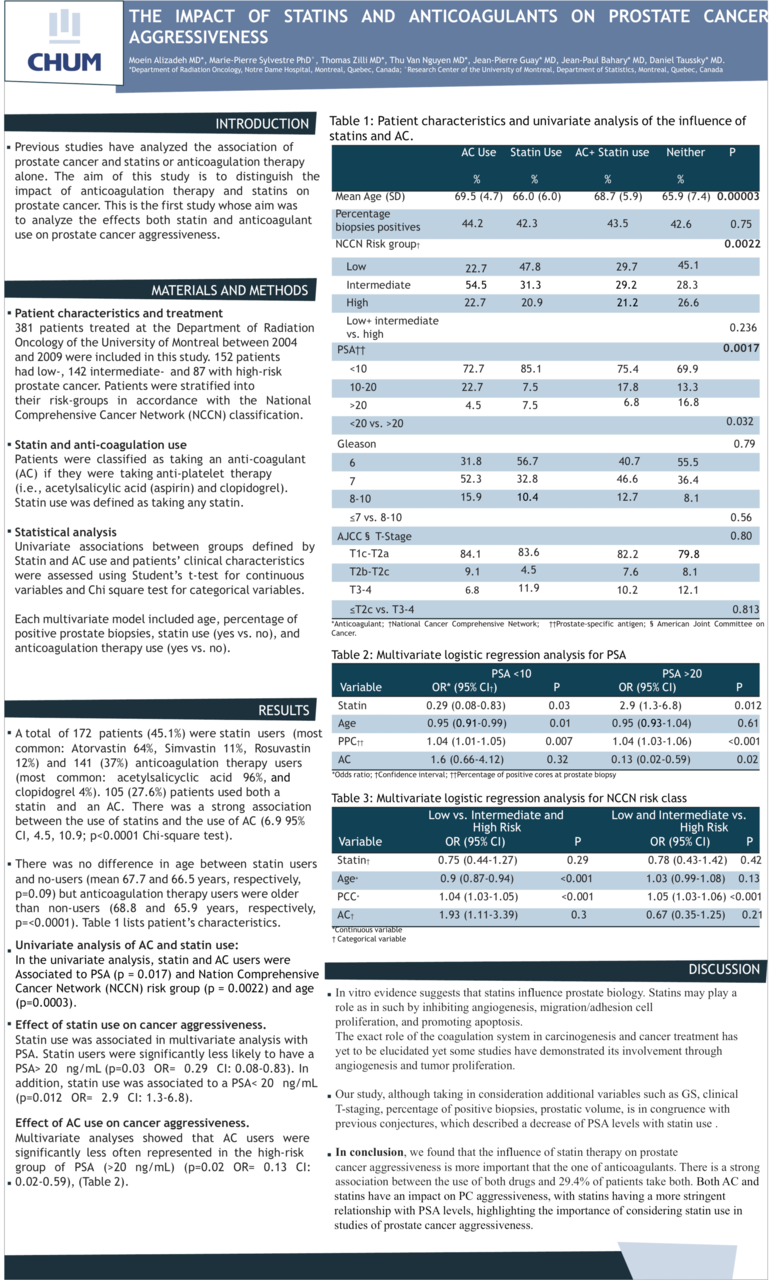
Purpose: Statins and anticoagulants (AC) have both been associated with a less aggressive prostate cancer and a better outcome after treatment of localized prostate cancer (PC). The results of these studies might be confounded by the fact that patients might often take both medications. We examined their respective influence on PC aggressiveness at initial diagnosis.
Methods: We analyzed 381 patients treated with either external beam radiation therapy or brachytherapy for low- (N=152), intermediate- (N=142) or high-risk (N=87) localized PC. Univariate and multivariate logistic regression analysis were used to investigate an association between these drug classes and prostate cancer aggressiveness. We tested whether the concomitant use of Statin and AC had a different effect than that of either AC or statin use alone.
Results: 172 patients (45.1%) were taking statins and 141 (37.0%) AC. 105 (27.6%) patients used both. In the univariate analysis, statin and AC users were associated to PSA (p = 0.017) and Nation Comprehensive Cancer Network (NCCN) risk group (p = 0.0022). In the multivariate analysis, statin use was associated with a PSA < 10 (OR = 2.9, 95% CI 1.3-6.8, p = 0.012) and a PSA > 20 (OR = 0.29, 95% CI 0.08-0.83, p = 0.03). The use of AC was associated with PSA > 20 (OR = 0.13, 95% CI 0.02-0.59, p = 0.02).
Conclusion: Both AC and statins have an impact on PC aggressiveness, with statins having a more stringent relationship with PSA levels, highlighting the importance of considering statin use in studies of prostate cancer aggressiveness.
Related articles